Combating Misinformation on Social Media
Combating Misinformation on Social Media
Understand how people fact-check online to design a seamless way to verify information on social media.
Understand how people fact-check online to design a seamless way to verify information on social media.

Overview
Overview
Social media is now a primary source of information, yet the rapid spread of misinformation makes it hard for users to know what to trust. This topic is personal to me because I personally have fall victim to misinformation.
The project is a class project that began as a team effort to research how people consume and fact-check news on social media. Building on our findings, I later designed a mobile plugin that integrates fact-checking directly into social media platforms without disrupting the user experience.
Social media is now a primary source of information, yet the rapid spread of misinformation makes it hard for users to know what to trust. This topic is personal to me because I personally have fall victim to misinformation.
The project is a class project that began as a team effort to research how people consume and fact-check news on social media. Building on our findings, I later designed a mobile plugin that integrates fact-checking directly into social media platforms without disrupting the user experience.
My role:
My role:
My role:
UX Research: I led a four-person research team by creating timelines, assigning tasks, reviewing deliverables, and facilitating synthesis sessions that turned data into insights and research outputs.
UX Research: I led a four-person research team by creating timelines, assigning tasks, reviewing deliverables, and facilitating synthesis sessions that turned data into insights and research outputs.
UI Design: I designed and tested a mobile plugin by creating wireframes and prototypes, then refined them based on user feedback.
UI Design: I designed and tested a mobile plugin by creating wireframes and prototypes, then refined them based on user feedback.
Method:
Method:
Method:
Contextual Inquiry, User Interview, Affinity Mapping, Persona and Scenario Writing, Journey Mapping, Wireframing, Prototyping, Usability Testing
Contextual Inquiry, User Interview, Affinity Mapping, Persona and Scenario Writing, Journey Mapping, Wireframing, Prototyping, Usability Testing
Tools:
Tools:
Tools:
FigJam, Figma, ATLAS.ti, and Zoom.
FigJam, Figma, ATLAS.ti, and Zoom.
Duration:
Duration:
Duration:
UX Research (Oct–Nov 2024, 6 weeks); UI Design (Feb–Mar 2025, 5 weeks)
UX Research (Oct–Nov 2024, 6 weeks); UI Design (Feb–Mar 2025, 5 weeks)
Problem Space
Problem Space
Social media has become an undeniable source of widespread misinformation. Yet there is still no reliable way for users to verify content for accuracy and bias.
Social media has become an undeniable source of widespread misinformation. Yet there is still no reliable way for users to verify content for accuracy and bias.
Central Question:
How might technology help users recognize and respond to misinformation more effectively?
Central Question:
How might technology help users recognize and respond to misinformation more effectively?
Central Question:
How might technology help users recognize and respond to misinformation more effectively?
Research Process
Research Process
Contextual Inquiries
Contextual Inquiries
We observed 6 participants...
We observed participants as they screen-shared while fact-checking a fabricated Facebook post titled “Pope Francis declared Donald Trump a Saint.” This allowed us to see their natural behaviors and key challenges during the fact-checking process.

We observed 6 participants...
We observed participants as they screen-shared while fact-checking a fabricated Facebook post titled “Pope Francis declared Donald Trump a Saint.” This allowed us to see their natural behaviors and key challenges during the fact-checking process.
We observed 6 participants...
We observed participants as they screen-shared while fact-checking a fabricated Facebook post titled “Pope Francis declared Donald Trump a Saint.” This allowed us to see their natural behaviors and key challenges during the fact-checking process.
Semi-Structured Interviews
Semi-Structured Interviews
We interviewed 8 participants...
We virtually interviewed participants to understand how people consume news and approach fact-checking. These interviews validated our contextual inquiry findings and provided deeper insight into user motivations and decision-making.
We interviewed 8 participants...
We virtually interviewed participants to understand how people consume news and approach fact-checking. These interviews validated our contextual inquiry findings and provided deeper insight into user motivations and decision-making.
We interviewed 8 participants...
We virtually interviewed participants to understand how people consume news and approach fact-checking. These interviews validated our contextual inquiry findings and provided deeper insight into user motivations and decision-making.
Thematic Coding and Affinity Mapping
Thematic Coding and Affinity Mapping
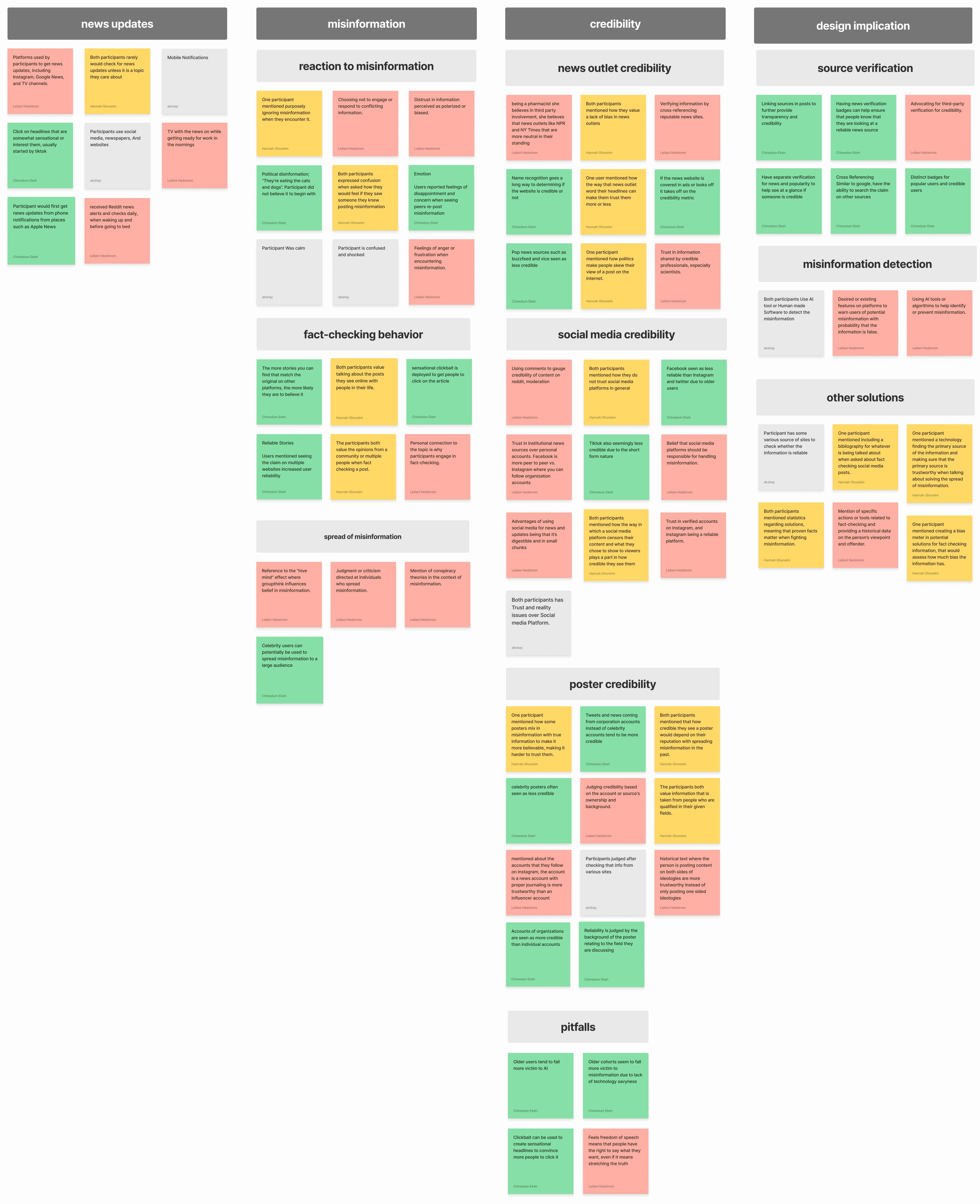
I led the team synthesis using ATLAS.ti to apply descriptive coding to transcripts and FigJam to organize data into affinity diagrams, which helped identify patterns that shaped our major themes.
I led the team synthesis using ATLAS.ti to apply descriptive coding to transcripts and FigJam to organize data into affinity diagrams, which helped identify patterns that shaped our major themes.
Affinity Diagram
Affinity Diagram
Key Themes
Key Themes
From our analysis, we identified 3 major themes.
From our analysis, we identified 3 major themes.
Theme 1:
Theme 1:
Users rely on social media sources like Instagram and Reddit for news because of their convenience and digestibility.
Users rely on social media sources like Instagram and Reddit for news because of their convenience and digestibility.
Participant 1
“You can see a snippet of the information and scroll through comments.”... “It’s in digestible chunks and easy to follow.”
Participant 1
“You can see a snippet of the information and scroll through comments.”... “It’s in digestible chunks and easy to follow.”
Participant 1
“You can see a snippet of the information and scroll through comments.”... “It’s in digestible chunks and easy to follow.”
Theme 2:
Theme 2:
Participants either searched Google or checked the poster’s account, spending about 5 minutes before often stopping short of fully debunking the post.
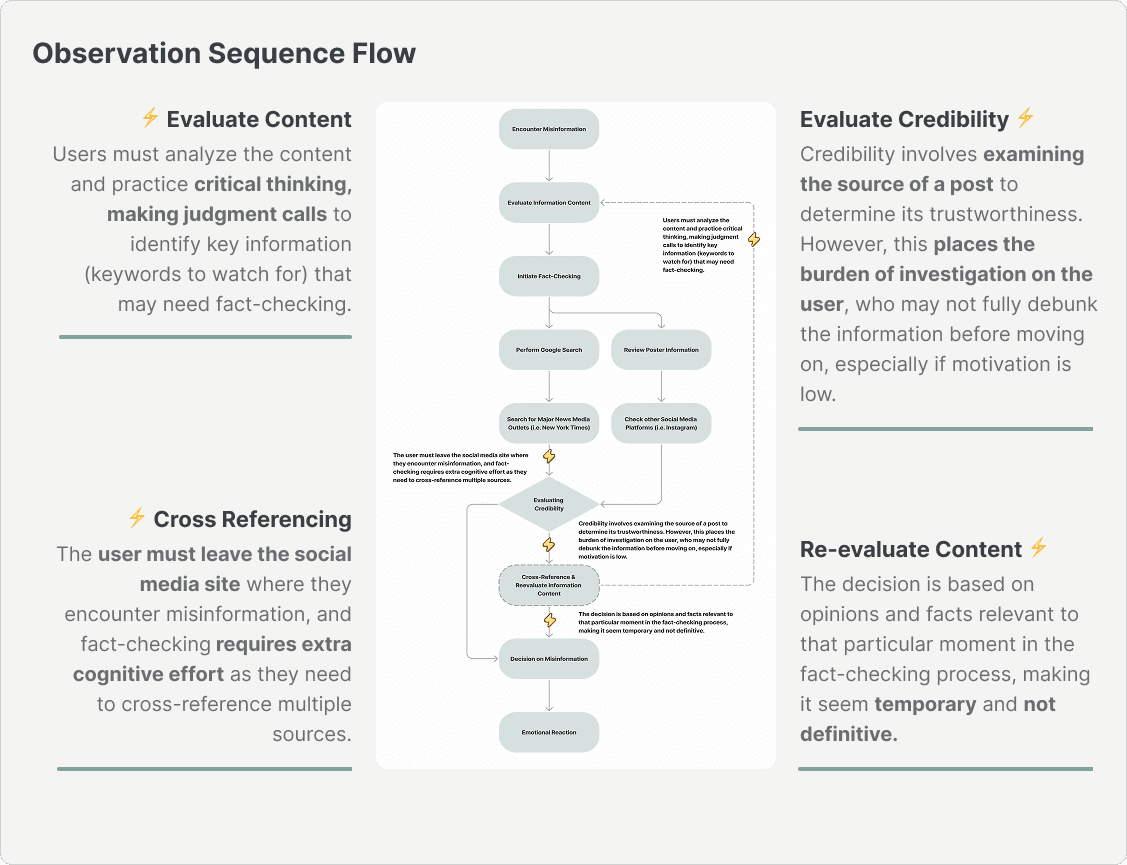
I created an observation sequence diagram that captured participant behavior during the study, revealing key decision points and breakdowns in the fact-checking process.
Participants either searched Google or checked the poster’s account, spending about 5 minutes before often stopping short of fully debunking the post.
I created an observation sequence diagram that captured participant behavior during the study, revealing key decision points and breakdowns in the fact-checking process.
Theme 3:
Theme 3:
Trust depends on the platform, the account owner, and the source. Content from credible news outlets or Reddit is seen as more trustworthy than posts from random users on Facebook.
Trust depends on the platform, the account owner, and the source. Content from credible news outlets or Reddit is seen as more trustworthy than posts from random users on Facebook.
Participant 2
“Social media accounts like NPR, the New York Times, and CNN hold high credibility to me.”... “some individual posting about information would hold less credibility to me.”
Participant 2
“Social media accounts like NPR, the New York Times, and CNN hold high credibility to me.”... “some individual posting about information would hold less credibility to me.”
Participant 2
“Social media accounts like NPR, the New York Times, and CNN hold high credibility to me.”... “some individual posting about information would hold less credibility to me.”
Research Study Limitations
Research Study Limitations
Representation Gaps:
Representation Gaps:
Representation Gaps:
The interview study lacked right-wing conservatives and participants over 35; future research should expand the sample for balanced political representation and include Gen X and Boomers.
The interview study lacked right-wing conservatives and participants over 35; future research should expand the sample for balanced political representation and include Gen X and Boomers.
Device Context:
Device Context:
Device Context:
Most participants used laptops in the observation study, though social media is typically accessed on mobile; future research should include devices like iPhones, Android phones, and tablets.
Most participants used laptops in the observation study, though social media is typically accessed on mobile; future research should include devices like iPhones, Android phones, and tablets.
Research Outputs
Research Outputs
Persona Spectrum
Persona Spectrum
We create the persona spectrum by analyzing participant demographics and behaviors.
Two main patterns emerged, forming the Investigative Millennial and the Overwhelmed Gen Z user.
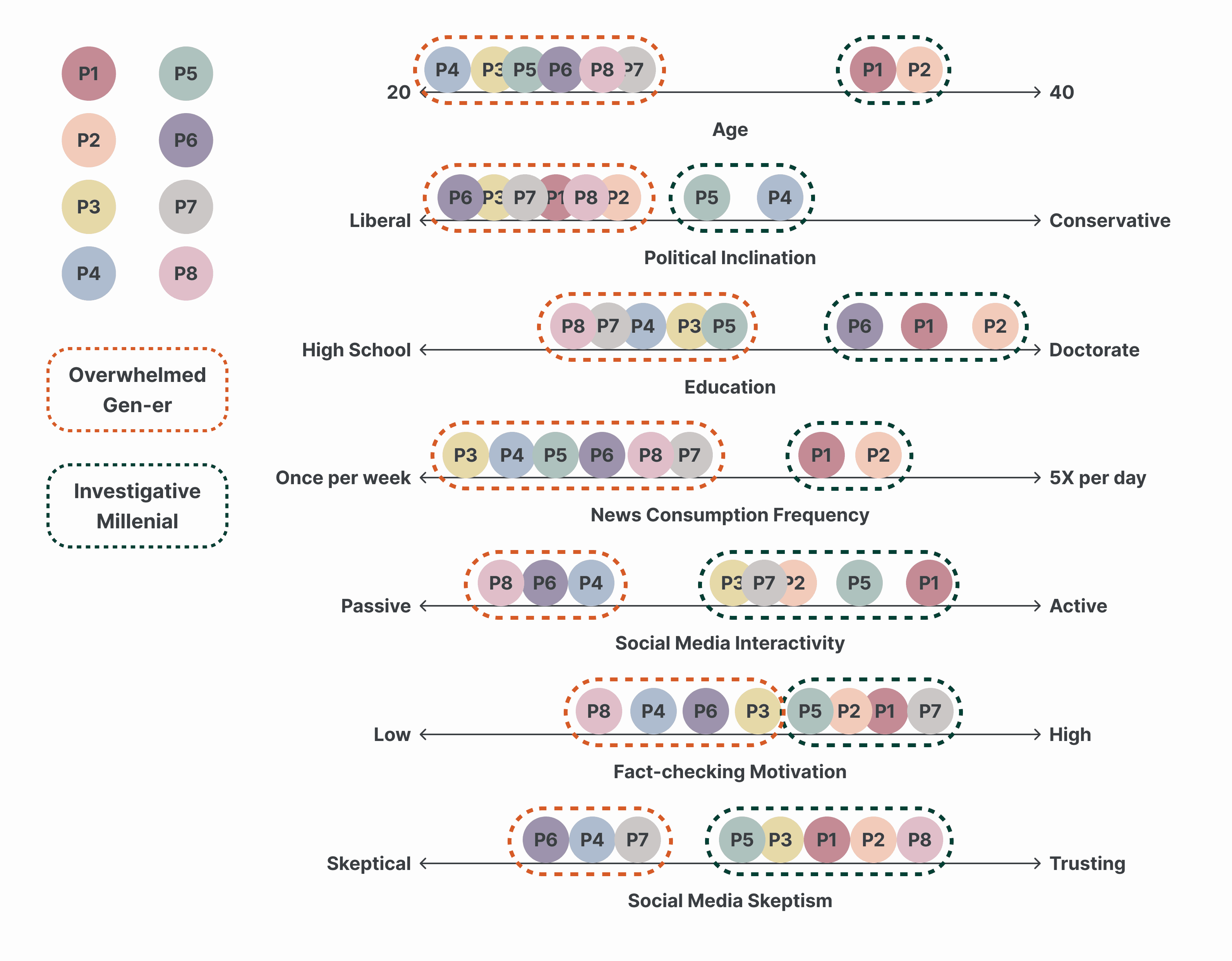
We create the persona spectrum by analyzing participant demographics and behaviors.
Two main patterns emerged, forming the Investigative Millennial and the Overwhelmed Gen Z user.
We create the persona spectrum by analyzing participant demographics and behaviors.
Two main patterns emerged, forming the Investigative Millennial and the Overwhelmed Gen Z user.
User Personas, and Journey Maps
User Personas, and Journey Maps
We created user scenarios, personas, journey maps to represent two typical user groups we previously identified and help us empathize and understand their needs.
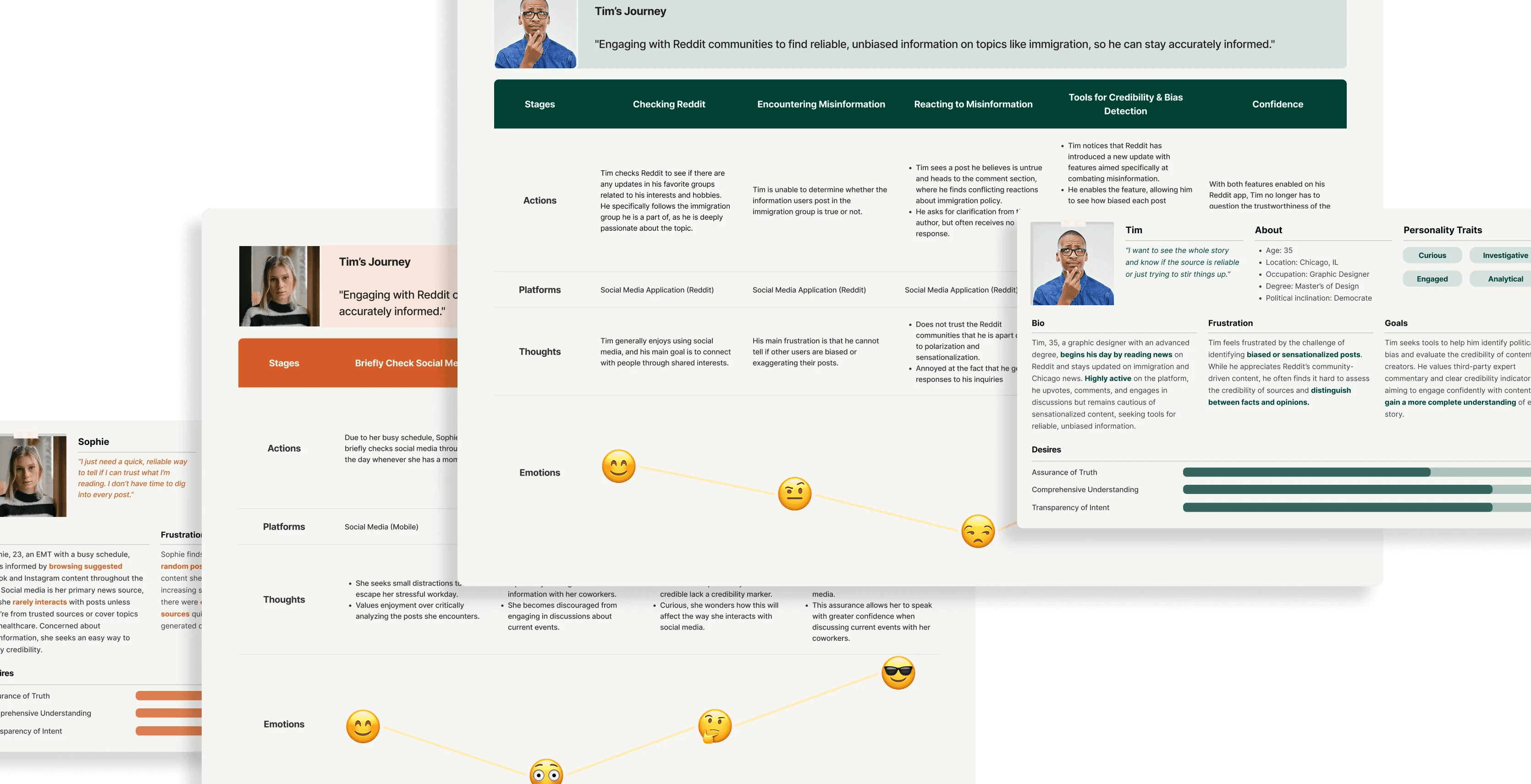
We created user scenarios, personas, journey maps to represent two typical user groups we previously identified and help us empathize and understand their needs.
We created user scenarios, personas, journey maps to represent two typical user groups we previously identified and help us empathize and understand their needs.
Priority Matrix
Priority Matrix
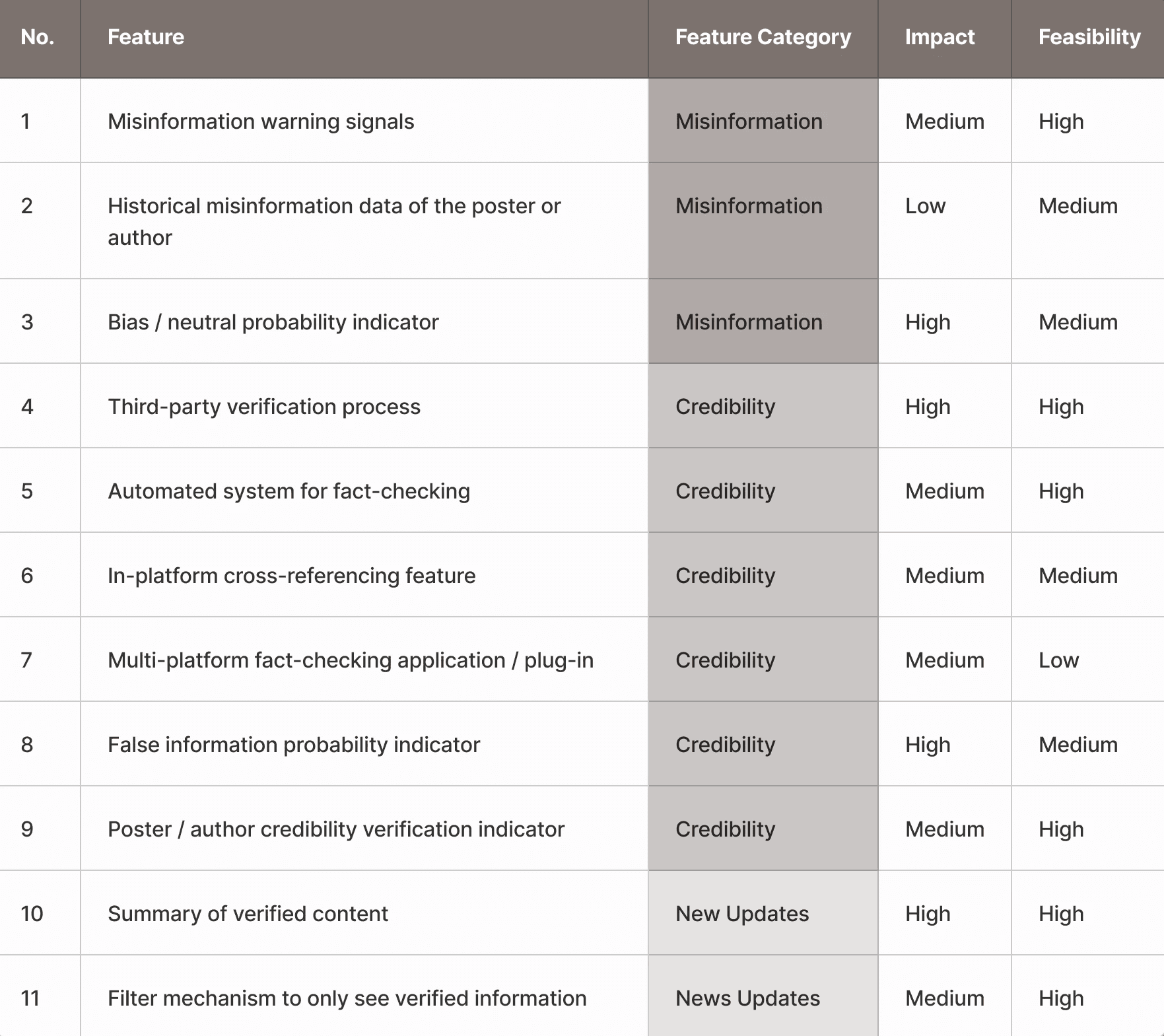
We then brainstormed 11 potential features and used a priority matrix to evaluate them based on feasibility and impact.
We grouped features into three main categories. The "misinformation" group warns users when content may be false. The "credibility" group provides objective fact-checking and verified information. And the "news updates" group offers a streamlined way to follow credible content.
We then brainstormed 11 potential features and used a priority matrix to evaluate them based on feasibility and impact.
We grouped features into three main categories. The "misinformation" group warns users when content may be false. The "credibility" group provides objective fact-checking and verified information. And the "news updates" group offers a streamlined way to follow credible content.
We then brainstormed 11 potential features and used a priority matrix to evaluate them based on feasibility and impact.
We grouped features into three main categories. The "misinformation" group warns users when content may be false. The "credibility" group provides objective fact-checking and verified information. And the "news updates" group offers a streamlined way to follow credible content.
Design Process
Design Process
Ideation and Wireframing
Ideation and Wireframing
Based on our research, I focused on 3 core features that revealed to be high impact and low effort from the priority matrix:
Based on our research, I focused on 3 core features that revealed to be high impact and low effort from the priority matrix:
Credible Feed:
Credible Feed:
Credible Feed:
Curated content verified by trusted sources
Curated content verified by trusted sources
Fact-checker Tool:
Fact-checker Tool:
Fact-checker Tool:
One-tap post verification within the app
One-tap post verification within the app
Credbility Sensor:
Credbility Sensor:
Credbility Sensor:
Visual rating for account trust
Visual rating for account trust
I created mobile wireframes since most social media activity happens on mobile devices.
I created mobile wireframes since most social media activity happens on mobile devices.
Mid-Fidelity Prototype
Mid-Fidelity Prototype
I translated the wireframes into a mid-fidelity mobile prototype using FigJam. The prototype focused on three core tasks:
I translated the wireframes into a mid-fidelity mobile prototype using FigJam. The prototype focused on three core tasks:
Signing up
Signing up
Signing up
Fact-checking a post
Fact-checking a post
Fact-checking a post
Reviewing account credibility
Reviewing account credibility
Reviewing account credibility
This allowed me to validate structure and usability before moving into higher fidelity design.
This allowed me to validate structure and usability before moving into higher fidelity design.
3. User Testing
3. User Testing
I conducted moderated usability testing with 2 participants using the mid-fidelity prototype. Participants completed 3 tasks:
I conducted moderated usability testing with 2 participants using the mid-fidelity prototype. Participants completed 3 tasks:
Signing up and link social media apps
Signing up and link social media apps
Signing up and link social media apps
Fact-checking a social media post
Fact-checking a social media post
Fact-checking a social media post
Viewing an account’s credibility level
Viewing an account’s credibility level
Viewing an account’s credibility level
Findings:
Findings:
Overall feedback was positive, with findings revealing design strengths and areas for improvement.
Overall feedback was positive, with findings revealing design strengths and areas for improvement.
Layout rated highly for clarity (5/5) and navigation (4.5/5)
Layout rated highly for clarity (5/5) and navigation (4.5/5)
Layout rated highly for clarity (5/5) and navigation (4.5/5)
They suggested stronger visual hierarchy and a “most flagged posts” tab
They suggested stronger visual hierarchy and a “most flagged posts” tab
They suggested stronger visual hierarchy and a “most flagged posts” tab
Users requested a short privacy statement during sign-up
Users requested a short privacy statement during sign-up
Users requested a short privacy statement during sign-up
These insights helped me refine the design to improve clarity and privacy transparency in the final design.
These insights helped me refine the design to improve clarity and privacy transparency in the final design.
Limitations:
Limitations:
User testing included only 2 participants, which limits generalizability. Future testing should include a larger sample size.
User testing included only 2 participants, which limits generalizability. Future testing should include a larger sample size.
User testing included only 2 participants, which limits generalizability. Future testing should include a larger sample size.
Final Design
Final Design
I created the final prototype in Figma, refining the design based on earlier feedback and strengthening how users understand credibility and privacy while interacting with content.
I created the final prototype in Figma, refining the design based on earlier feedback and strengthening how users understand credibility and privacy while interacting with content.
Reflection
Reflection
This project strengthened my research skills and deepened my understanding of observation methods. Through contextual inquiry, I saw how users’ real behaviors differ from what they say online. This revealed insights that led to more accurate design decisions. Experiencing the full process from research to solution showed me that good design begins with understanding the problem before building the solution.
This project strengthened my research skills and deepened my understanding of observation methods. Through contextual inquiry, I saw how users’ real behaviors differ from what they say online. This revealed insights that led to more accurate design decisions. Experiencing the full process from research to solution showed me that good design begins with understanding the problem before building the solution.