Augmented Reality Campus Tour
Augmented Reality Campus Tour
Reimagine campus exploration through augmented reality.
Reimagine campus exploration through augmented reality.

Overview
Overview
Campus tours often feel rushed and impersonal, which makes it hard for prospective students to imagine life on campus. The Augmented Reality Campus (ARC) project was a grant-funded, student-led summer project at DePaul University. Our team designed an interactive mobile AR experience using Google’s Geospatial and ARCore technologies to transform traditional campus tours into bite-sized, engaging, self-guided exploration.
Campus tours often feel rushed and impersonal, which makes it hard for prospective students to imagine life on campus. The Augmented Reality Campus (ARC) project was a grant-funded, student-led summer project at DePaul University. Our team designed an interactive mobile AR experience using Google’s Geospatial and ARCore technologies to transform traditional campus tours into bite-sized, engaging, self-guided exploration.
Team:
Team:
Team:
I collaborated with another UX/UI Designer, an AR Developer, and a 3D Designer.
I collaborated with another UX/UI Designer, an AR Developer, and a 3D Designer.
My role:
My role:
My role:
Project Lead: I led a 4-person team and managed deliverables, meetings, and documentation to keep a cross-disciplinary team aligned.
Project Lead: I led a 4-person team and managed deliverables, meetings, and documentation to keep a cross-disciplinary team aligned.
UX/UI Lead: I led user research, design decisions, and overall project direction. Created user journeys, flows, mockups, and prototypes, and coordinated design handoffs.
UX/UI Lead: I led user research, design decisions, and overall project direction. Created user journeys, flows, mockups, and prototypes, and coordinated design handoffs.
Method:
Method:
Method:
Persona Creation, Journey Mapping, UI System Design, Wireframing, Prototyping, and Field Testing.
Persona Creation, Journey Mapping, UI System Design, Wireframing, Prototyping, and Field Testing.
Tools:
Tools:
Tools:
Figma, FigJam, Unity, ARCore, Cesium, ZBrush, Maya, Google Geospatial Creator, Notion, and Zoom.
Figma, FigJam, Unity, ARCore, Cesium, ZBrush, Maya, Google Geospatial Creator, Notion, and Zoom.
Duration:
Duration:
Duration:
June - September 2025 (13 weeks)
June - September 2025 (13 weeks)
Context
Context
ARC began as a PUSH Studio project exploring Google Geospatial technology to support campus safety at DePaul University. Early work included interviews with campus security, but then the project later evolved into a campus tour application through a co-design session with the campus tour office. I continued the project by applying for DePaul’s IMPACT Summer Grant. I led proposal writing, team recruitment, and project direction after acceptance.
ARC began as a PUSH Studio project exploring Google Geospatial technology to support campus safety at DePaul University. Early work included interviews with campus security, but then the project later evolved into a campus tour application through a co-design session with the campus tour office. I continued the project by applying for DePaul’s IMPACT Summer Grant. I led proposal writing, team recruitment, and project direction after acceptance.
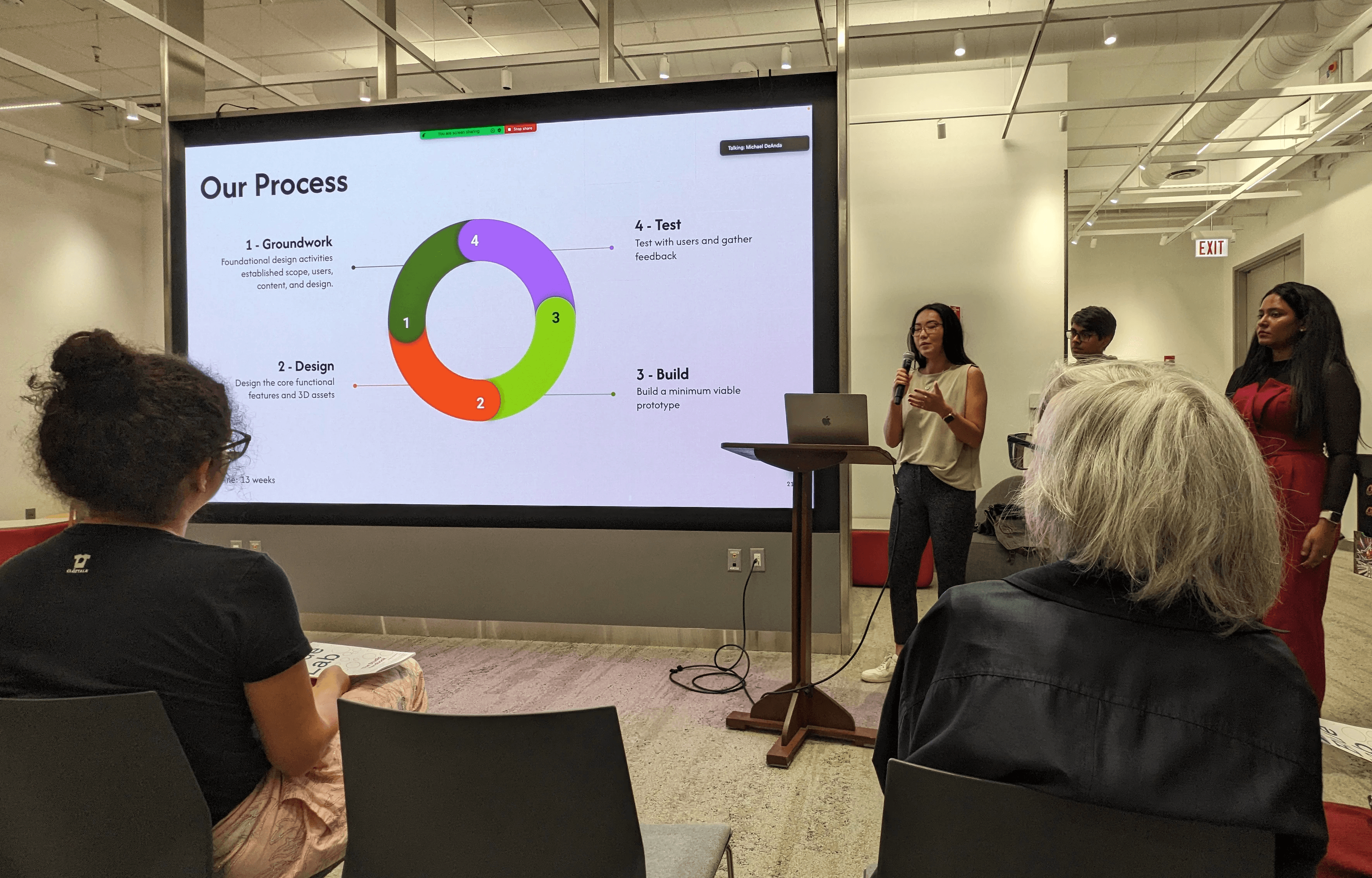
Image: IMPACT Showcase where the team presented our work on ARC.
Image: IMPACT Showcase where the team presented our work on ARC.
Problem Space
Problem Space
Campus tours are often time-limited and one-size-fits-all. Visitors receive surface-level information and miss opportunities to hear student perspectives. ARC aimed to address this gap by making campus tours more personal and interactive through augmented reality.
Campus tours are often time-limited and one-size-fits-all. Visitors receive surface-level information and miss opportunities to hear student perspectives. ARC aimed to address this gap by making campus tours more personal and interactive through augmented reality.
Central Question:
How might we use Augmented Reality technology to make campus exploration more engaging, informative, and interactive?
Central Question:
How might we use Augmented Reality technology to make campus exploration more engaging, informative, and interactive?
Central Question:
How might we use Augmented Reality technology to make campus exploration more engaging, informative, and interactive?
Process
Process
1. Laying the Groundwork
1. Laying the Groundwork
We reviewed prior research and findings from a student-led co-design session with campus tour guides. This work identified 3 audience groups: prospective students, parents, and current students, and outlined potential product features.
We reviewed prior research and findings from a student-led co-design session with campus tour guides. This work identified 3 audience groups: prospective students, parents, and current students, and outlined potential product features.
I helped the team focus on prospective students as they would benefit the most from ARC. This narrowed the scope and defined 5 core features that shaped the design:
I helped the team focus on prospective students as they would benefit the most from ARC. This narrowed the scope and defined 5 core features that shaped the design:
Building Cards:
Building Cards:
Building Cards:
Short snippets highlighting each building and showcasing the university.
Short snippets highlighting each building and showcasing the university.
Internal Resources:
Internal Resources:
Internal Resources:
Visual cues showing amenities inside buildings.
Visual cues showing amenities inside buildings.
Safety Feature:
Safety Feature:
Safety Feature:
Clear signals marking campus safety call boxes.
Clear signals marking campus safety call boxes.
Shuttle Stops:
Shuttle Stops:
Shuttle Stops:
Markers showing inter-campus shuttle locations.
Markers showing inter-campus shuttle locations.
Statue Information:
Statue Information:
Statue Information:
Fun snippets about statues and their history.
Fun snippets about statues and their history.
I created personas and journey maps using FigJam to capture the emotional experience of prospective students using ARC. From this exercise, I help the team better defined ARC’s scope as both a guided tour companion and a stand-alone tool for self-guided exploration to give visitors flexibility in how they experience campus.
I created personas and journey maps using FigJam to capture the emotional experience of prospective students using ARC. From this exercise, I help the team better defined ARC’s scope as both a guided tour companion and a stand-alone tool for self-guided exploration to give visitors flexibility in how they experience campus.
2. Designing Core Features
2. Designing Core Features
Design System
Design System
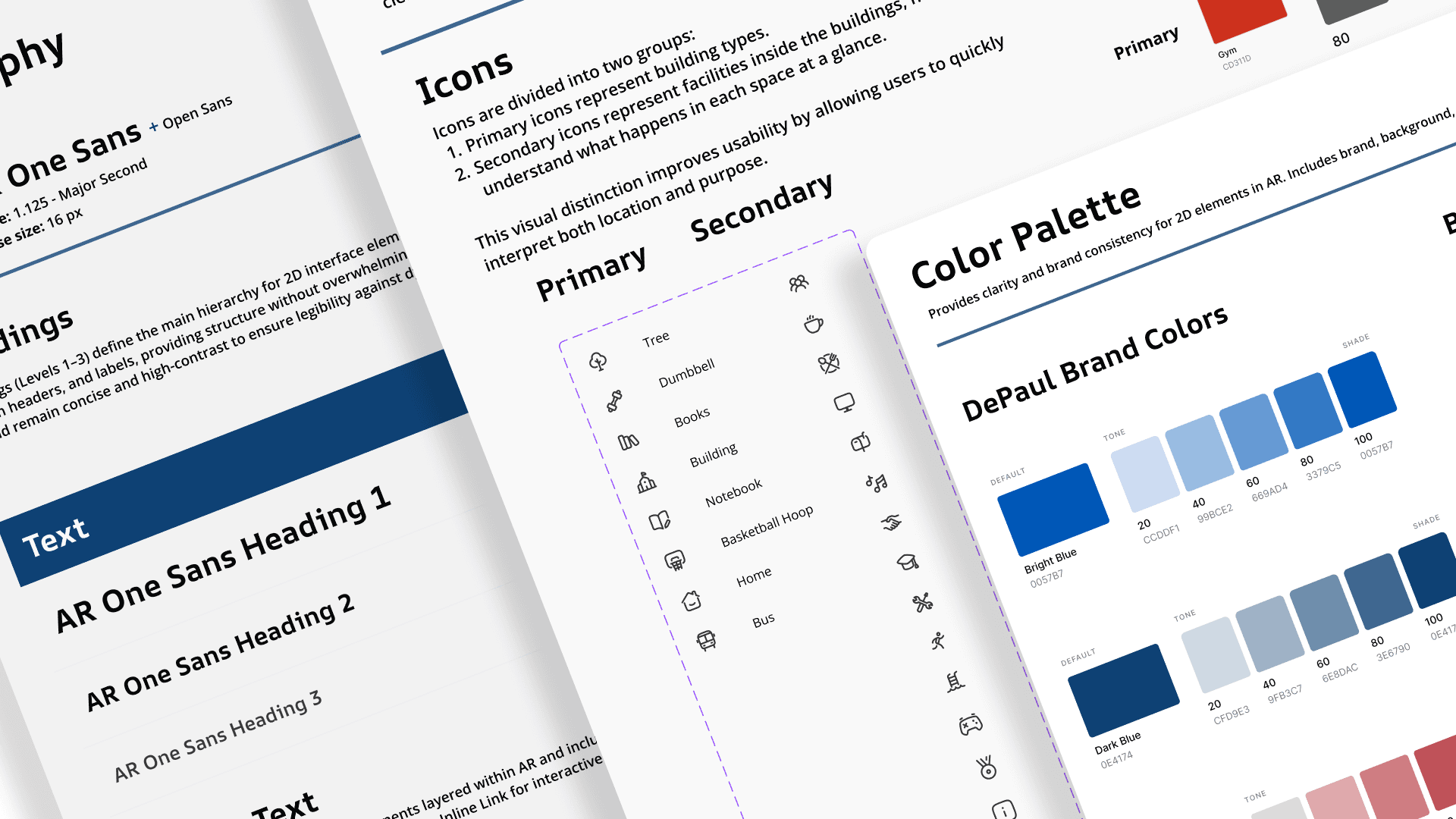
In Figma, we built a cohesive UI system that included typography, colors, and iconography based on DePaul’s brand.
In Figma, we built a cohesive UI system that included typography, colors, and iconography based on DePaul’s brand.
Typography:
Typography:
Typography:
I chose AR One Sans for headings because it provides clarity in augmented reality environments, and Open Sans for body text for balance and readability.
I chose AR One Sans for headings because it provides clarity in augmented reality environments, and Open Sans for body text for balance and readability.
Colors:
Colors:
Colors:
I used high-contrast colors for outdoor visibility and assigned distinct colors to each building category.
I used high-contrast colors for outdoor visibility and assigned distinct colors to each building category.
Icons:
Icons:
Icons:
I created 2 icon groups: primary icons for building types and secondary icons for internal amenities and resources.
I created 2 icon groups: primary icons for building types and secondary icons for internal amenities and resources.
Components and User Flow
Components and User Flow
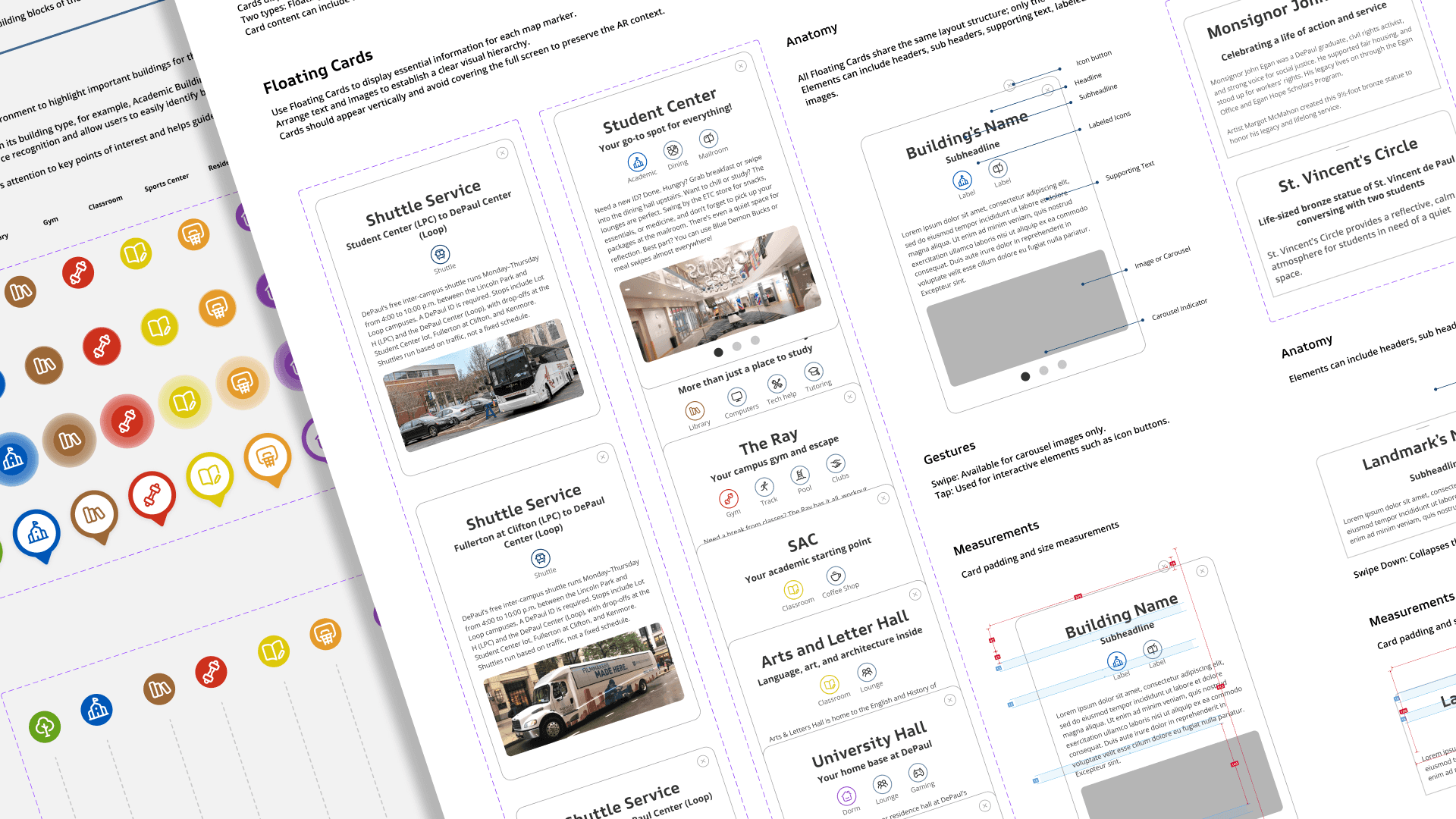
We refined UI components through several Figma iterations and defined an ideal user flow for their use.
We refined UI components through several Figma iterations and defined an ideal user flow for their use.
Final Design
Final Design
Before developer handoff, I created a semi-interactive Figma prototype that included the following:
Before developer handoff, I created a semi-interactive Figma prototype that included the following:
Interactive map markers that pulse for visibility, with color-coded icons for quick recognition.
Interactive map markers that pulse for visibility, with color-coded icons for quick recognition.
Concise information cards for buildings, statues, and shuttle stops highlighting details students care about.
Concise information cards for buildings, statues, and shuttle stops highlighting details students care about.
Icon system displayed in the building cards showing building resources and amenities.
Icon system displayed in the building cards showing building resources and amenities.
Beaming safety lights indicating the location of public safety call boxes.
Beaming safety lights indicating the location of public safety call boxes.
2D/3D Assets
2D/3D Assets
I collaborated with our 3D designer who created 2D street signs and 3D University-themed assets using Maya and ZBrush, including a model of DePaul’s mascot Dibs. These assets supported the visual appeal of the AR environment but were not included in user testing.
I collaborated with our 3D designer who created 2D street signs and 3D University-themed assets using Maya and ZBrush, including a model of DePaul’s mascot Dibs. These assets supported the visual appeal of the AR environment but were not included in user testing.
Build A Minimum Viable Prototype
Build A Minimum Viable Prototype
Using ARCore, Google’s Geospatial, and Cesium SDKs, the team built a working prototype. We refined outdoor visibility and tested tap and swipe gestures.
During development, we found a limitation in Google’s Geospatial anchors that caused AR objects to appear inconsistently. This issue had gone unnoticed because earlier tests were done in controlled environments with clear surroundings and stable Wi-Fi.
Using ARCore, Google’s Geospatial, and Cesium SDKs, the team built a working prototype. We refined outdoor visibility and tested tap and swipe gestures.
During development, we found a limitation in Google’s Geospatial anchors that caused AR objects to appear inconsistently. This issue had gone unnoticed because earlier tests were done in controlled environments with clear surroundings and stable Wi-Fi.
Field Testing Video
Field Testing Video
Test with Users
Test with Users
I planned and led field user testing on DePaul’s Lincoln Park campus with 4 participants who were asked to imagine themselves as prospective students on a guided tour while interacting with ARC.
I planned and led field user testing on DePaul’s Lincoln Park campus with 4 participants who were asked to imagine themselves as prospective students on a guided tour while interacting with ARC.
Findings
Findings
Building information cards were most helpful.
Building information cards were most helpful.
Building information cards were most helpful.
Safety blue lights needed better onboarding.
Safety blue lights needed better onboarding.
Safety blue lights needed better onboarding.
Overall enjoyment rated 3/5.
Overall enjoyment rated 3/5.
Overall enjoyment rated 3/5.
Pointing a phone mid-sidewalk looked distracting to bystanders.
Pointing a phone mid-sidewalk looked distracting to bystanders.
Pointing a phone mid-sidewalk looked distracting to bystanders.
Limitations
Limitations
The geospatial anchoring issue caused inconsistent prototype performance, which likely affected testers’ overall experience.
The geospatial anchoring issue caused inconsistent prototype performance, which likely affected testers’ overall experience.
The geospatial anchoring issue caused inconsistent prototype performance, which likely affected testers’ overall experience.
3 of the 4 participants were current students. Although I asked them to act as prospective students, their feedback reflected their existing familiarity with campus.
3 of the 4 participants were current students. Although I asked them to act as prospective students, their feedback reflected their existing familiarity with campus.
3 of the 4 participants were current students. Although I asked them to act as prospective students, their feedback reflected their existing familiarity with campus.
Future Work
Future Work
Future versions will explore alternative AR frameworks to improve anchor stability.
Future versions will explore alternative AR frameworks to improve anchor stability.
Future versions will explore alternative AR frameworks to improve anchor stability.
We plan to expand the user audience to include parents and focus more on independent, self-guided, and customizable experiences.
We plan to expand the user audience to include parents and focus more on independent, self-guided, and customizable experiences.
We plan to expand the user audience to include parents and focus more on independent, self-guided, and customizable experiences.
We also aim to add stationary physical markers that let users view AR content more comfortably and reduce disruption to bystanders.
We also aim to add stationary physical markers that let users view AR content more comfortably and reduce disruption to bystanders.
We also aim to add stationary physical markers that let users view AR content more comfortably and reduce disruption to bystanders.
Reflection
Reflection
This was my first time leading a cross-disciplinary project, and I learned how communication nuances can cause confusion when words carry different meanings across fields. Establishing a common language early helps prevent setbacks later.
We discovered Google’s geospatial limitations at a late stage, which slowed our progress and created uncertainty about continuing user testing. I learned the importance of testing technical capabilities in the field since performance often depends on environmental conditions.
It was also my first experience designing and conducting a field user test. The process was valuable, revealing how people naturally interacted with ARC in a live campus setting.
This was my first time leading a cross-disciplinary project, and I learned how communication nuances can cause confusion when words carry different meanings across fields. Establishing a common language early helps prevent setbacks later.
We discovered Google’s geospatial limitations at a late stage, which slowed our progress and created uncertainty about continuing user testing. I learned the importance of testing technical capabilities in the field since performance often depends on environmental conditions.
It was also my first experience designing and conducting a field user test. The process was valuable, revealing how people naturally interacted with ARC in a live campus setting.